Fire Suppression Drone

System Overview

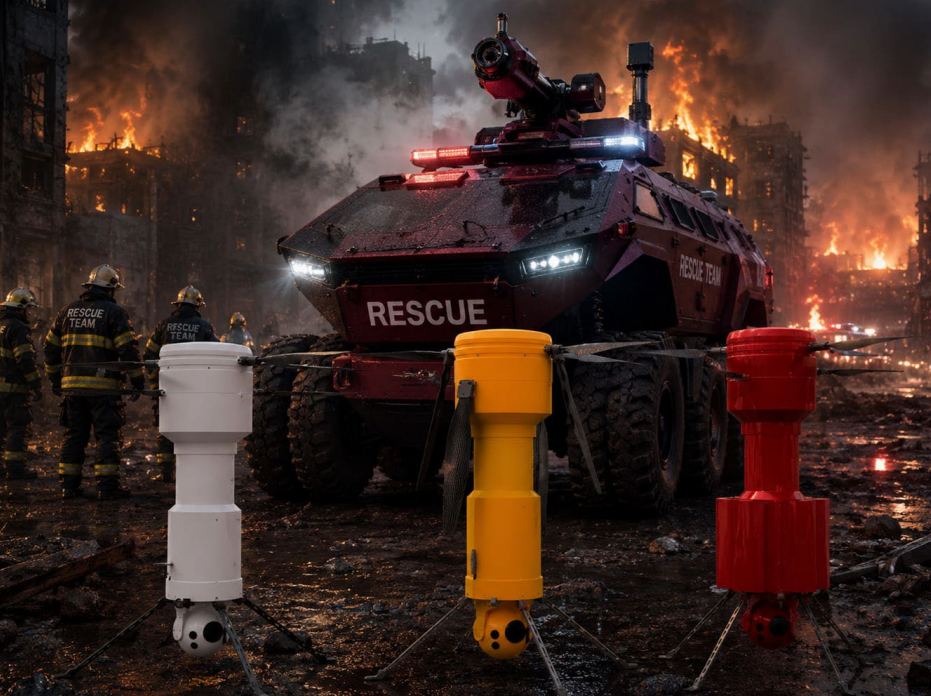
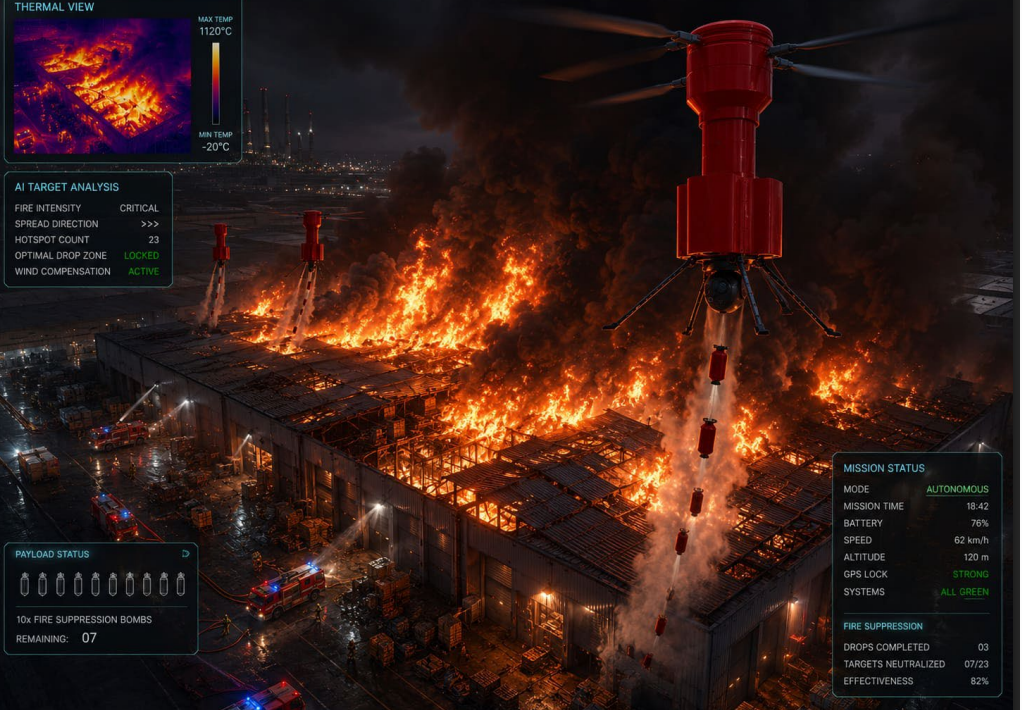
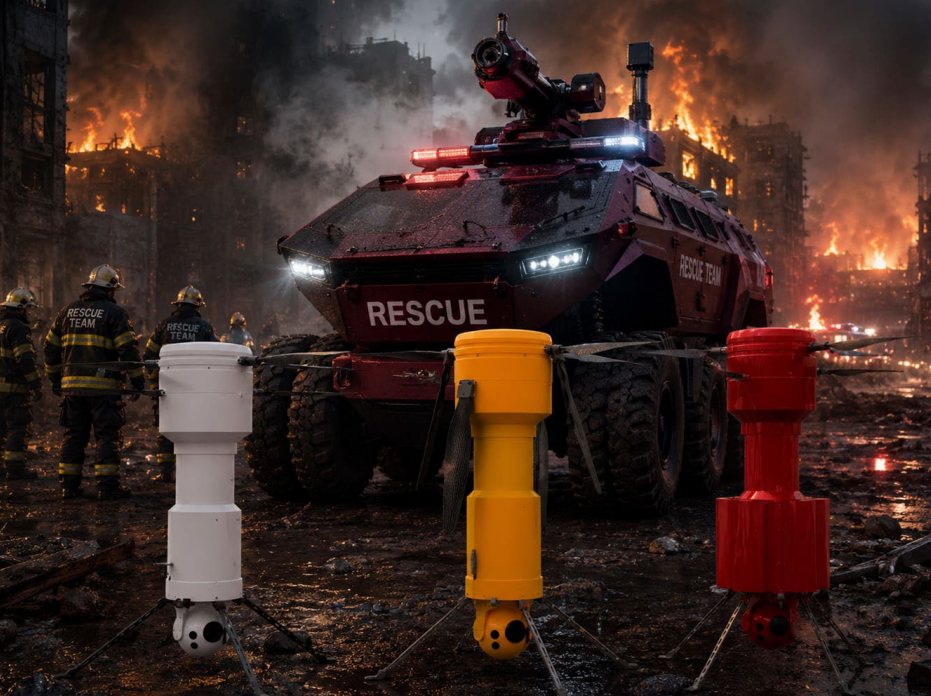
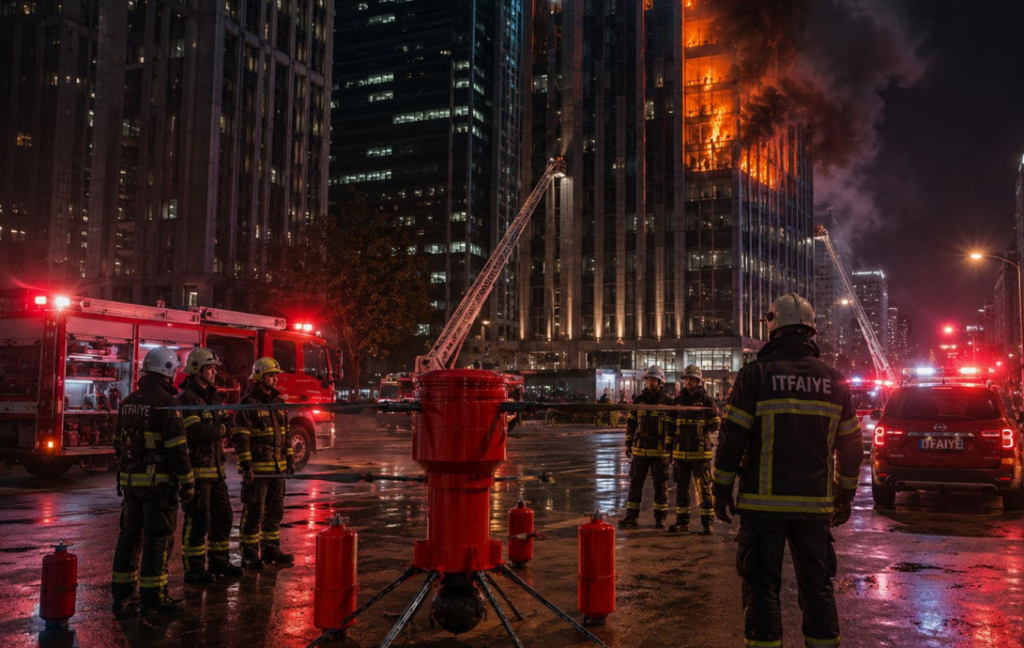
The Fire Suppression Drone is a fully electric, AI-powered autonomous aerial firefighting platform designed for rapid response in dangerous wildfire, industrial fire, offshore platform, and urban emergency environments.

The system combines:

  • Heavy-lift autonomous flight capability
  • AI-assisted thermal fire analysis
  • Autonomous fire suppression bomb deployment
  • Thermal & optical target acquisition
  • Real-time mission planning
  • Fully autonomous navigation and return systems

The drone is designed to operate in environments too dangerous for human firefighters and conventional helicopters.

Primary Mission Capabilities

Autonomous Fire Detection

The drone continuously scans the operational area using:

  • Thermal imaging systems
  • AI thermal hotspot analysis
  • Real-time environmental mapping
  • Smoke penetration imaging

The onboard AI identifies:

  • Fire origin points
  • High-temperature concentration zones
  • Fire spread direction
  • Structural collapse risk
  • Dangerous heat accumulation

Autonomous Fire Suppression

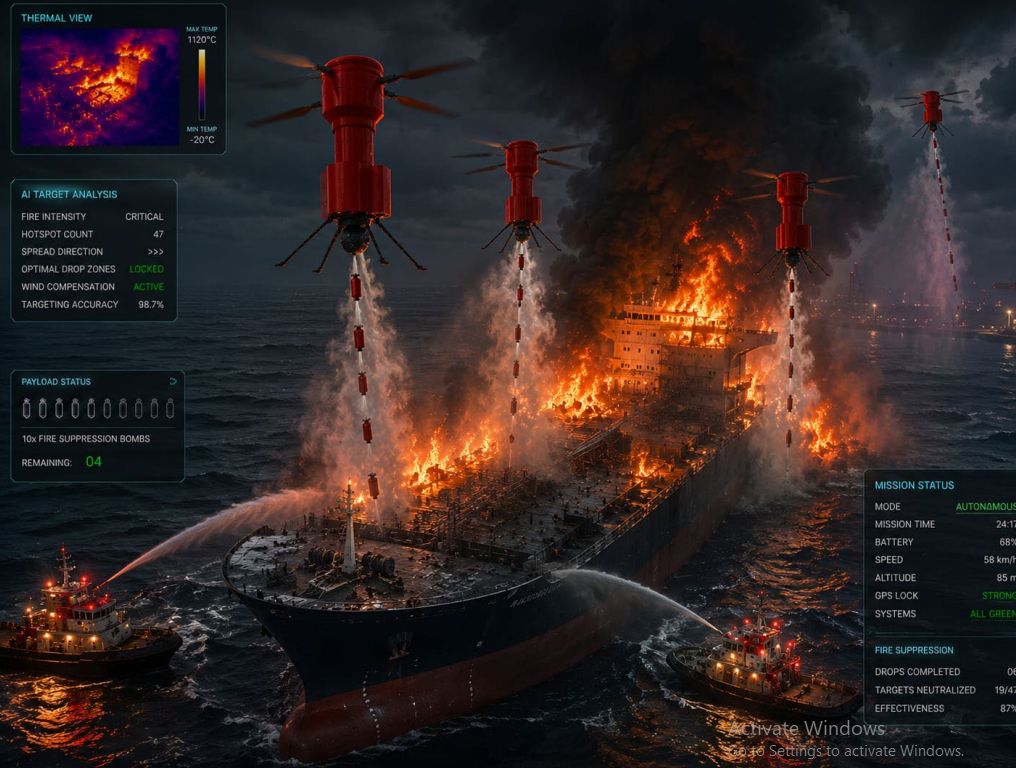
The drone carries multiple fire suppression bombs and autonomously calculates:

  • Optimal drop altitude
  • Best release timing
  • Wind compensation
  • Fire intensity mapping
  • Spread prediction

The AI system determines the most effective impact location without requiring manual operator control.

The system can deploy:

  • Dry chemical suppression bombs
  • Foam payloads
  • Fire retardant capsules
  • Thermal isolation agents

Thermal & Optical Intelligence

The drone integrates:

  • 10x Optical Zoom Camera

Provides:

  • Long-range visual inspection
  • Structural assessment
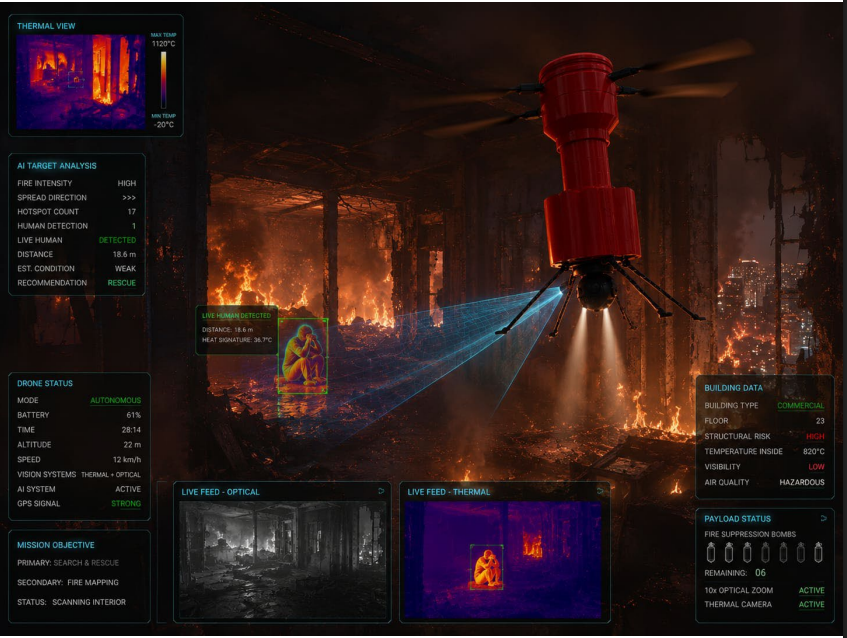
  • Human target identification
  • Precision mission confirmation

Thermal Camera System Provides

  • Fire hotspot detection
  • Smoke penetration capability
  • Temperature mapping
  • Night operation capability
  • Victim detection in low visibility environments

Technical Specifications

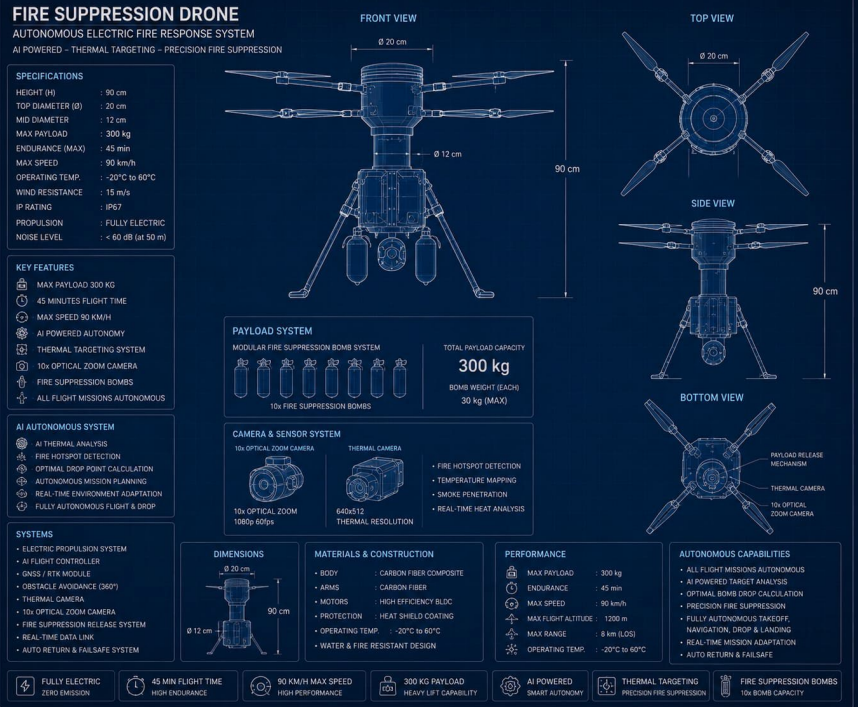
SpecificationValue
Height90 cm
Top Diameter20 cm
Mid Diameter12 cm
Maximum Payload300 kg
Flight Time45 Minutes
Maximum Speed90 km/h
PropulsionFully Electric
Flight TypeAutonomous VTOL
IP RatingIP67
Wind Resistance15 m/s
Operating Temperature-20°C to +60°C

AI Autonomous Flight System

The drone is capable of fully autonomous operations including:

  • Autonomous takeoff
  • Autonomous navigation
  • Autonomous fire analysis
  • Autonomous target prioritization
  • Autonomous payload deployment
  • Autonomous landing
  • Emergency return-to-home
  • Dynamic route optimization

The onboard AI continuously evaluates:

  • Wind conditions
  • Fire behavior
  • Heat intensity
  • Terrain obstacles
  • Structural risks
  • GPS position
  • Battery status

Fire Targeting AI

The integrated AI engine processes thermal camera data in real time.

AI Functionalities

  • Heat Source Analysis

Identifies:

  • Main fire source
  • Secondary ignition points
  • Heat concentration areas
  • Fire Spread Prediction

Calculates:

  • Fire movement direction
  • Expansion speed
  • Potential future ignition zones
  • Autonomous Bomb Release

The AI determines:

  • Exact release coordinates
  • Drop timing
  • Payload selection
  • Release sequence

Electric Propulsion System

The drone uses a high-efficiency electric propulsion architecture designed for:

  • High payload operations
  • Low acoustic signature
  • Rapid acceleration
  • Stable hovering
  • Long endurance missions

Structural Design

he drone body is constructed using:

  • Carbon fiber composite materials
  • Heat-resistant structural coatings
  • High-temperature resistant electronics isolation
  • Reinforced payload mounting systems

Advantages of Fully Electric Design

  • Zero direct emissions
  • Reduced maintenance
  • Lower operational cost
  • Faster mission readiness
  • Lower thermal signature
  • Improved reliability

The airframe is optimized for:

  • Heavy payload stability
  • Thermal resistance
  • Low aerodynamic drag
  • High maneuverability

Camera & Sensor Systems

Thermal Camera

  • High sensitivity thermal imaging
  • Smoke penetration capability
  • Real-time heat visualization
  • Hotspot identification

10x Optical Zoom Camera

  • Long-range target acquisition
  • High-definition visual confirmation
  • Day/night operational support

Navigation Sensors

  • GNSS / RTK positioning
  • IMU stabilization
  • Altitude sensors
  • Obstacle avoidance sensors
  • Environmental awareness sensors

Operational Scenarios

Wildfire Operations

  • Fire line suppression
  • Hotspot neutralization
  • Thermal reconnaissance

Industrial Fire Response

  • Chemical plant fires
  • Fuel storage fires
  • Refinery incidents

Offshore Platform Operations

  • Oil & gas platform fires
  • Marine emergency response

Autonomous Mission Flow

Step 1 – Area Scan

  • Thermal sensors scan the operational area.

Step 2 – AI Fire Analysis

The AI identifies:

  • Fire center
  • Temperature intensity
  • Spread direction

Step 3 – Threat Evaluation

The drone calculates:

  • Risk zones
  • Safe approach path
  • Optimal release altitude

Step 4 – Autonomous Payload Deployment

  • Suppression bombs are autonomously deployed.

Step 5 – Real-Time Assessment

  • Thermal systems verify suppression effectiveness.

Step 6 – Mission Continuation

The drone either:

  • Continues suppression
  • Returns for reload
  • Switches to reconnaissance mode

Core Advantages

  • Fully autonomous operation
  • Heavy payload capacity
  • High-speed response
  • AI-assisted fire suppression
  • Precision thermal targeting
  • Long-range reconnaissance
  • Electric propulsion
  • Compact deployable structure
  • Minimal human risk exposure
  • Multi-environment operational capability

Conclusion

The Autonomous Fire Suppression Drone represents a next-generation firefighting platform combining:

  • Artificial intelligence
  • Thermal targeting
  • Heavy-lift electric propulsion
  • Autonomous mission execution
  • Precision fire suppression

The system is designed to dramatically improve response speed, operational safety, and fire suppression efficiency in extreme environments where conventional firefighting systems face major limitations.