AI Enhanced Firefighter Helmet

Overview

The AI-Enhanced Firefighter Helmet System is a next-generation intelligent rescue helmet designed for firefighters operating in extreme fire, smoke, heat, and hazardous gas environments.

Core Design Philosophy

The system is designed to improve:

  • Firefighter survival
  • Rescue efficiency
  • Navigation in zero-visibility conditions
  • Victim detection
  • Real-time command center awareness

The helmet combines:

  • Artificial Intelligence
  • 360° situational awareness
  • Thermal and infrared vision
  • Health monitoring systems
  • GPS tracking
  • Real-time communication systems
  • Hazard detection algorithms
  • Advanced heat-resistant materials

Core System Capabilities

Fully Electric Power System

Electric Power Components

Battery System

  • High-capacity lithium battery pack
  • Fire-resistant battery compartment
  • Thermal insulated battery housing
  • Smart battery management system BMS

Electric Motors

  • Independent wheel drive architecture
  • High torque low-speed operation
  • Precision maneuver capability

Power Distribution

  • Intelligent energy balancing
  • Redundant power pathways
  • Emergency backup systems

Core System Capabilities

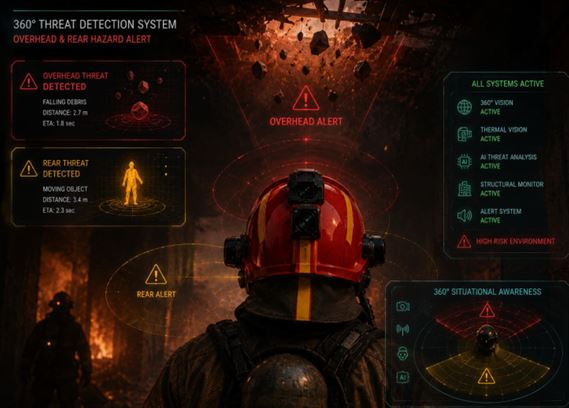
360° Camera Awareness System The helmet uses multiple ultra-wide-angle cameras positioned around the helmet shell to provide the user with a complete 360-degree field of view.

Capabilities

  • Detect movement around the firefighter
  • Identify falling debris
  • Detect approaching hazards
  • Eliminate blind spots
  • Assist navigation in narrow environments

Suggested Hardware:

  • Sony STARVIS low-light sensors
  • NVIDIA Jetson Orin Nano / Xavier NX
  • Qualcomm Robotics RB5
  • Wide-angle thermal-resistant camera modules

Hardware Components

  • Wide-angle low-light cameras
  • AI vision processor
  • Embedded GPU module
  • Real-time image stitching system

Software

  • Computer Vision Algorithms
  • Real-time Object Detection
  • Motion Tracking
  • AI Threat Recognition
  • SLAM — Simultaneous Localization and Mapping

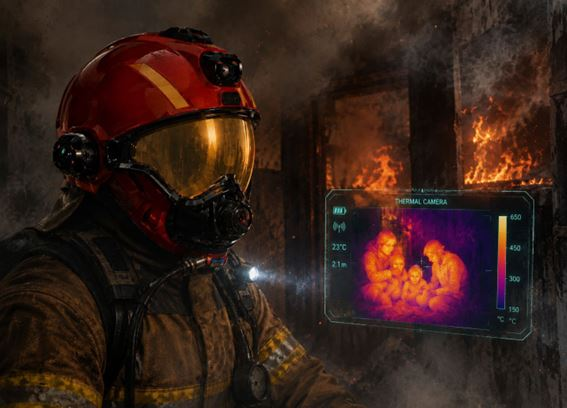
Thermal & Infrared Vision System

The helmet integrates thermal imaging and infrared vision systems allowing firefighters to see through dense smoke and dark environments.

Capabilities

  • Detect human heat signatures
  • Navigate through smoke
  • Identify fire hotspots
  • Locate trapped victims
  • Detect hidden fire sources inside walls or structures

Suggested Thermal Hardware

  • FLIR Boson Thermal Camera
  • Seek Thermal Industrial Module
  • LWIR infrared sensors
  • Heat-resistant optical lenses

Thermal Vision Features

  • Heat mapping
  • Human body recognition
  • Temperature analysis
  • Fire source localization
  • Dynamic thermal overlay

Software

  • AI thermal analysis
  • Human detection algorithms
  • Heat source classification
  • Fire behavior prediction
  • Thermal tracking engine

AI Hazard Detection System

The helmet’s onboard AI continuously analyzes the environment and warns the user about possible dangers.

Detectable Threats

  • Structural collapse risks
  • Flashover conditions
  • Extreme heat zones
  • Explosive temperature increases
  • Toxic smoke concentration
  • Dangerous movement nearby

Software Technologies

  • Machine Learning Models
  • Deep Neural Networks
  • Edge AI Processing
  • Sensor Fusion Systems

AI Functions

  • Threat prioritization
  • Real-time alerts
  • Audio guidance
  • Visual HUD warnings
  • Predictive fire spread estimation

AI Processing Hardware

  • NVIDIA Jetson Series
  • Intel Movidius AI Accelerators
  • Embedded ARM processors
  • Dedicated AI coprocessors

Victim Detection System

The helmet can identify trapped civilians inside burning structures using thermal vision and AI-assisted human recognition.

Capabilities

  • Detect body heat
  • Identify movement
  • Recognize human shapes
  • Mark victim locations
  • Send victim coordinates to command center

Detection Features

  • Child detection
  • Motion analysis
  • Thermal contrast tracking
  • AI rescue assistance

Benefits

  • Faster rescue operations
  • Reduced firefighter risk
  • Improved victim survival rates

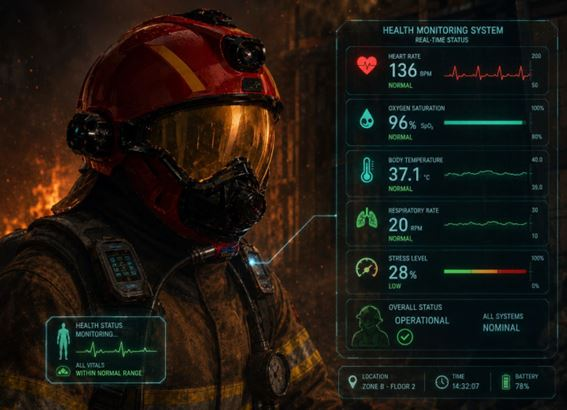
Health Monitoring System

Health Monitoring System

Integrated biometric sensors continuously monitor the firefighter’s physical condition.

Monitored Data

  • Heart rate
  • Oxygen saturation SpO2
  • Body temperature
  • Stress level
  • Breathing rate
  • Fatigue indicators

Suggested Sensors

  • MAX30102 Pulse Oximeter
  • ECG Sensors
  • Skin Temperature Sensors
  • Respiratory Monitoring Sensors

Emergency Alerts

The system automatically alerts command personnel if:

  • Heart rate becomes dangerous
  • Oxygen levels drop
  • Heat stress becomes critical
  • Firefighter becomes unconscious

Software

  • Health analytics
  • Emergency medical alerts
  • Fatigue prediction AI

GPS & Tracking System

The helmet contains an integrated GPS and indoor positioning support system.

Features

  • Real-time firefighter tracking
  • Indoor positioning assistance
  • Team coordination
  • Rescue team monitoring
  • Emergency extraction assistance

Suggested Hardware

  • u-blox GPS modules
  • UWB indoor positioning systems
  • Inertial navigation systems
  • IMU sensors

Communication Features

  • Command center integration
  • Live map transmission
  • Route tracking
  • Position history logging

Software

  • Mapping systems
  • Position tracking algorithms
  • Indoor localization software
  • Rescue coordination software

Communication System

The helmet contains integrated communication hardware enabling continuous communication even in difficult environments.

Features

  • Noise cancellation
  • Team communication
  • Voice command system
  • Push-to-talk integration
  • Emergency communication priority

Software

  • Voice recognition AI
  • Digital signal processing
  • Emergency voice prioritization

Suggested Hardware

  • Military-grade microphones
  • Bone conduction speakers
  • Digital radio systems
  • Mesh networking modules

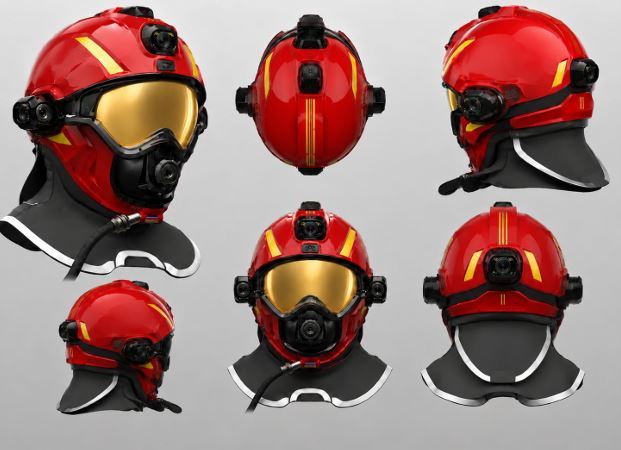
Heat Resistant Helmet Structure

The helmet shell is designed using advanced high-temperature-resistant materials.

Shell Characteristics

  • Extreme heat resistance
  • Low thermal transfer
  • Impact resistance
  • Flame resistance
  • Lightweight structure

Possible Materials

  • Carbon fiber composites
  • Kevlar layers
  • Aramid fibers
  • Ceramic thermal coatings
  • Nomex reinforced structures

Protective Neck & Fabric System

The lower neck protection system is designed to protect the firefighter from:

  • Toxic gases
  • Extreme heat
  • Smoke penetration
  • Thermal radiation
  • Fabric Characteristics
  • Flame retardant
  • Heat insulating
  • Chemical resistant
  • Breathable structure

Suggested Materials

  • Nomex
  • Kevlar fabric
  • PBI fibers
  • Carbon-based thermal barriers

Head-Up Display (HUD)

The visor can project important operational data directly into the firefighter’s field of vision.

HUD Information

  • Thermal overlay
  • Navigation guidance
  • Victim detection markers
  • Oxygen status
  • Health data
  • GPS direction
  • Team positions
  • Hazard warnings

Possible Technologies

  • Transparent OLED displays
  • AR projection systems
  • Optical waveguide displays

Power System

The helmet operates using a modular smart battery system.

Power Features

  • Hot-swappable batteries
  • Long operational duration
  • Smart power management
  • Emergency backup mode

Suggested Battery Types

  • Li-ion high-density batteries
  • Heat-protected battery housing
  • Intelligent battery management systems

Software Architecture

Main Software Components

  • AI Threat Detection Engine
  • Thermal Processing Software
  • Health Monitoring Software
  • Navigation Software
  • Communication Software
  • Sensor Fusion Engine
  • HUD Interface System

Programming Technologies

  • Python
  • C++
  • CUDA
  • TensorFlow
  • PyTorch
  • ROS2 — Robot Operating System

Possible Future Features

Future Expansion Ideas

  • Drone integration
  • AI voice assistant
  • Automatic route planning
  • Gas composition analysis
  • Augmented reality overlays
  • Real-time building mapping
  • Multi-user tactical network

Conclusion

The AI-Enhanced Firefighter Helmet System represents a new generation of intelligent rescue equipment designed to maximize firefighter safety and rescue effectiveness.

By integrating AI technologies, thermal imaging, sensor fusion, health monitoring, GPS tracking, and advanced communications, the system significantly improves operational awareness and survival capability in high-risk fire environments.

This concept can evolve into a fully integrated smart firefighting ecosystem suitable for:

  • Urban rescue teams
  • Industrial firefighting
  • Military rescue operations
  • Airport fire response
  • Hazardous material response team