Autonomous Fire Suppression Vehicle

Overview

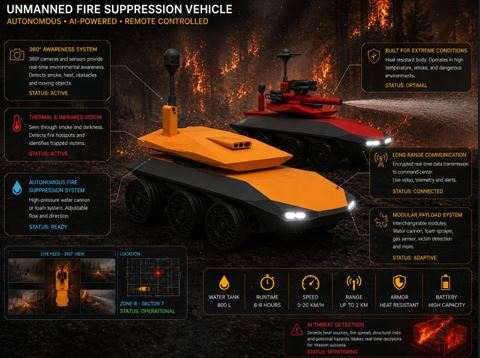
The Autonomous Fire Suppression Vehicle AFSV is a next-generation unmanned emergency response platform designed for firefighting, search & rescue, hazardous environment operations, and autonomous disaster intervention.

The system combines:

  • Fully Electric Propulsion
  • Amphibious Mobility
  • AI-Assisted Navigation
  • Thermal & Infrared Detection
  • Remote & Autonomous Operation
  • Compact Tactical Design
  • Extreme Heat Resistance

The vehicle is designed to operate in locations that are too dangerous for human firefighters.

Core Design Philosophy

The platform was developed around three critical principles:
A.Human Safety First

The vehicle enters dangerous environments before human teams.

Compact Multi-Environment Mobility

Its small dimensions allow operation inside:

  • Narrow urban streets
  • Underground facilities
  • Industrial complexes
  • Parking garages
  • Airports
  • Tunnels
  • Forest areas
  • Desert terrain
  • Marina environments
  • Flooded areas

Autonomous Emergency Capability

The system continuously analyzes the environment using AI and onboard sensors.

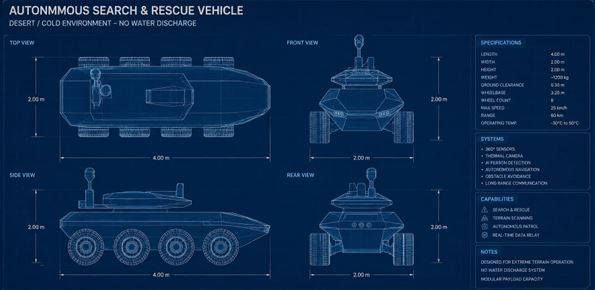
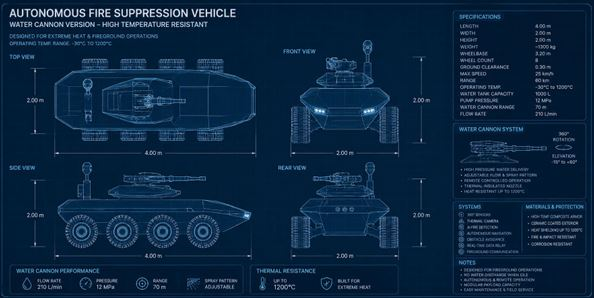
Vehicle Dimensions

Parameter

Value

Length

4.0 m

Width

2.0 m

Height

2.0 m

Wheel Count

8

Weight

~1300 kg

Ground Clearance

0.30 m

Compact dimensions allow transportation by:

  • Standard trailers
  • Cargo aircraft
  • Tactical transport vehicles
  • Amphibious deployment platforms

Fully Electric Power System

Zero Emission Electric Platform

The vehicle operates using a fully electric drivetrain.

Advantages of Electric Architecture

  • Silent operation
  • Low thermal signature
  • Reduced maintenance
  • Instant torque delivery
  • Better low-speed control
  • No engine combustion risk
  • Reliable indoor operation
  • Reduced fuel logistics

Fully Electric Power System

Electric Power Components

Battery System

  • High-capacity lithium battery pack
  • Fire-resistant battery compartment
  • Thermal insulated battery housing
  • Smart battery management system BMS

Electric Motors

  • Independent wheel drive architecture
  • High torque low-speed operation
  • Precision maneuver capability

Power Distribution

  • Intelligent energy balancing
  • Redundant power pathways
  • Emergency backup systems

Amphibious Capability

Amphibious Features

  • Sealed electronic compartments
  • Waterproof propulsion architecture
  • Corrosion-resistant body
  • Water-capable drivetrain
  • Stabilized floating structure

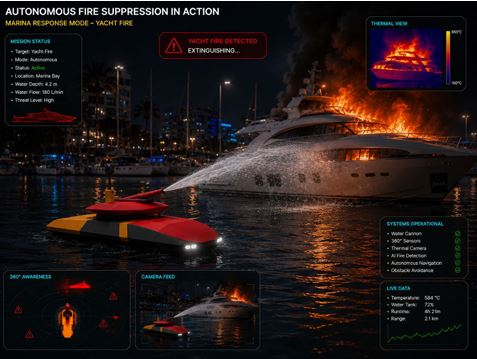
Amphibious Mission Types

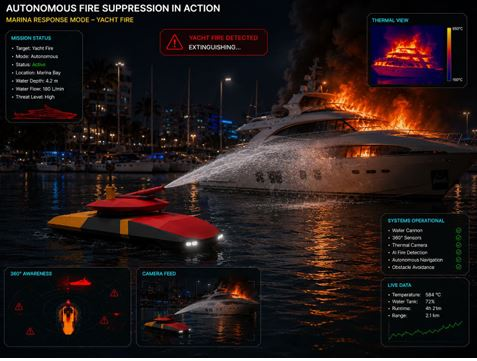
  • Marina Fire Response
  • Yacht fires
  • Harbor accidents
  • Fuel dock incidents
  • Flood Rescue

Example

  • Urban flood response
  • Submerged road operations
  • Coastal Emergency Support
  • Beach rescue operations
  • Offshore infrastructure support

Fire Suppression System

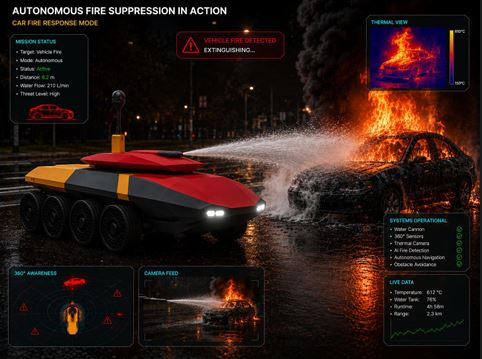
The vehicle uses an autonomous stabilized fire suppression turret.

Capabilities

  • Long-range water projection
  • Adjustable spray pattern
  • High-pressure operation
  • Foam compatibility
  • Precision targeting
  • Fire Suppression Specifications

    Parameter

    Value

    Water Tank Capacity

    1000 L

    Pump Pressure

    12 MPa

    Water Cannon Range

    70 m

    Flow Rate

    210 L/min

Extreme Heat Resistance

The vehicle is engineered for high-temperature operations.

Protection Systems

  • Ceramic-coated exterior armor
  • Multi-layer heat insulation
  • Thermal shielding panels
  • Heat-resistant electronics compartment
  • Fire-resistant cable routing

Operating Temperature

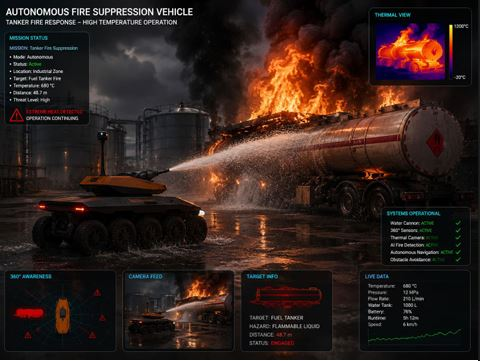
  • Up to 1200°C localized exposure

AI Powered Sensor System

The platform continuously analyzes the environment using AI-supported sensors.

360° Awareness System

Sensor Suite

  • Multi-camera array
  • LiDAR sensors
  • Obstacle detection radar
  • Motion tracking sensors

Functions

  • Collision prevention
  • Autonomous navigation
  • Hazard detection
  • Route optimization

Thermal & Infrared Vision

The vehicle can operate in:

  • Dense smoke
  • Complete darkness
  • Dust storms
  • Fog environments
  • Underground facilities
  • Thermal Vision Capabilities

Detects:

  • Fire hotspots
  • Human heat signatures
  • Structural heat buildup
  • Dangerous temperature zones

Supports:

  • Victim rescue
  • Fire source localization
  • Safe navigation paths

Autonomous Search & Rescue

The vehicle can be configured for rescue missions.

Rescue Operations

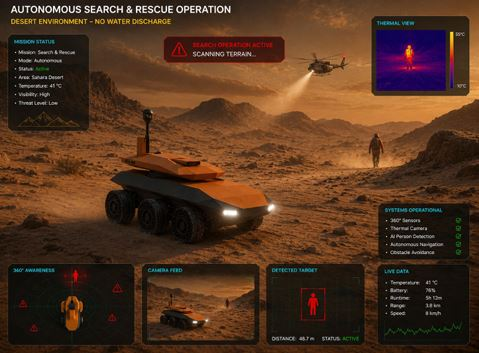
  • Desert search
  • Forest rescue
  • Industrial accident response
  • Urban disaster response
  • Earthquake zones

AI Person Detection

Using AI image processing, the system can:

  • Detect humans
  • Track movement
  • Identify heat signatures
  • Estimate safe approach routes

Remote Operation System

The vehicle can operate in Fully Autonomous Mode or Remote Controlled Mode.

Communication Systems Features

  • Encrypted data transmission
  • Real-time telemetry
  • Live camera streaming
  • GPS tracking
  • Command center integration
  • Supported Networks
  • RF communication
  • LTE/5G
  • Satellite communication
  • Mesh tactical networking

GPS & Navigation

Integrated Navigation Suite Includes

  • GPS
  • Inertial Navigation System INS
  • Terrain mapping
  • Autonomous pathfinding
  • Navigation Features
  • Waypoint missions
  • Autonomous patrol
  • Return-to-base function
  • Obstacle avoidance

Modular Mission Architecture

The platform supports modular payload systems.

Possible Configurations

Firefighting Version

  • Water cannon
  • Foam system

Search & Rescue Version

  • Thermal scanner
  • Medical supply module

Hazardous Materials Version

  • Gas sensors
  • Radiation sensors

Industrial Inspection Version

  • Thermal inspection camera
  • Mapping sensors

Advantages of Compact Size

Unlike large fire trucks, the AFSV can operate in restricted environments.

Operational Advantages

  • Indoor maneuverability
  • Tunnel access
  • Narrow street access
  • Lightweight transportability
  • Rapid deployment
  • Amphibious flexibility

Software & AI Systems

Core Software Technologies

  • AI Processing
  • Computer Vision AI
  • Object Detection Algorithms
  • Thermal Image Analysis
  • Autonomous Navigation AI

Control Software

  • Real-time vehicle management
  • Sensor fusion system
  • Threat analysis engine
  • Mission planning software

Possible Technology Stack

System

Example Technologies

AI Processing

NVIDIA Jetson / CUDA AI

Navigation

ROS2

Mapping

SLAM Algorithms

Thermal Processing

FLIR SDK

Communication

Encrypted RF / LTE

Operational Use Cases

  • Firefighting
  • Urban fires
  • Industrial fires
  • Vehicle fires
  • Marina fires
  • Search & Rescue
  • Desert rescue
  • Snow rescue
  • Disaster zones
  • Industrial Safety
  • Oil & gas facilities
  • Refineries
  • Chemical plants
  • Military & Civil Defense
  • Hazardous area reconnaissance
  • Emergency support operations

Future Expansion Options

Planned Upgrades

  • Swarm coordination
  • Autonomous drone integration
  • Robotic arm module
  • AI predictive fire analysis
  • Water mist systems
  • Hydrogen-electric hybrid option

Conclusion

The Autonomous Fire Suppression Vehicle is a next-generation unmanned emergency response platform combining:

  • Swarm coordination
  • Fully Electric Architecture
  • Amphibious Mobility
  • AI-Assisted Operations
  • Thermal & Infrared Vision
  • Compact Tactical Dimensions
  • Extreme Heat Resistance
  • Autonomous Navigation
  • Search & Rescue Capability

The platform is designed to reduce human risk while increasing operational efficiency in the world’s most dangerous emergency environments.